


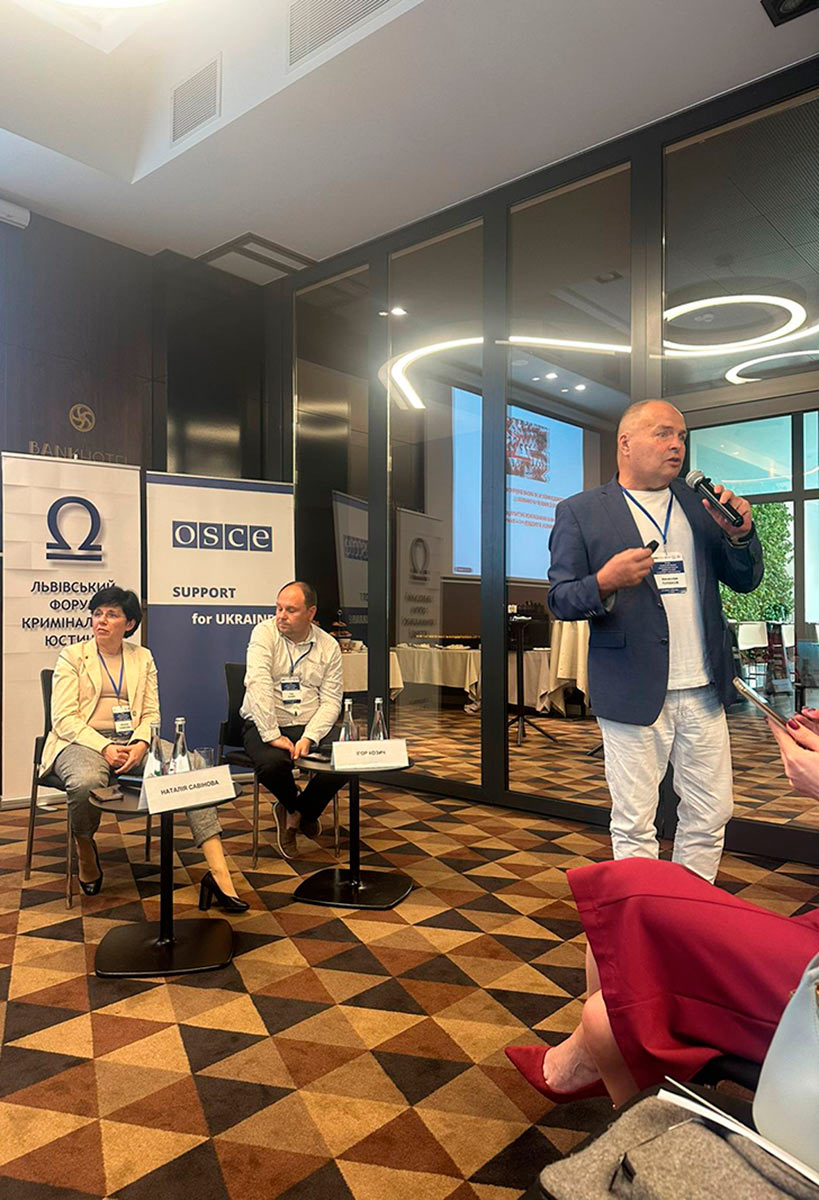
On June 4-5, 2025, the XI (24th) Lviv Criminal Justice Forum was held in Lviv. This year’s theme, «War and Peace & Crime and Punishment», served as a platform for discussing the most pressing challenges facing the criminal justice system in times of armed conflict and post-war transformation.
The Forum was co-organized by the OSCE Support Programme for Ukraine, the State Bureau of Investigation, and the NGO «Lviv Criminal Justice Forum». The event brought together around one hundred participants representing state authorities, the judiciary, law enforcement, the academic community, and civil society. Odesa’s institutions of higher education were represented by Doctor of Law Nataliia Savinova, Doctor of Law Viacheslav Tuliakov, and PhD in Law Liliia Timofieieva.
A key moment of the Forum was the presentation by Doctor of Law, Professor of Criminal Law at the National University «Odesa Law Academy», Corresponding Member of the National Academy of Legal Sciences of Ukraine, and Council of Europe Expert, Viacheslav Tuliakov, entitled: «Key Agents of Change: Responsibility for International Crimes Against Women».
In his presentation, Professor Tuliakov addressed a broader range of issues than the title might suggest. He discussed not only women as victims of war crimes but also emphasized the need to recognize victims of crime, offenders, and members of civil society as active agents of change in shaping criminal policy – particularly in the processes of criminalization and decriminalization. The methodology for assessing these changes was a key focus of his analysis.
When examining crime, criminality, or the effectiveness of proposed countermeasures, one may use weighting coefficients or sensitivity analyses – but the best approach is to do things right from the beginning, so that there’s no need to «patch things up» later.
Analyzing crime without victims, criminality without victimization, or punishment without offenders reflects only a partial view of a complex and sensitive issue.
The lesson?
Method matters. The method used to explore crime and criminality is crucial. If you're searching for causal relationships, you’ll need one kind of sample. If you're simply describing trends, a different one will be more appropriate. If a researcher cannot explain why they selected particular participants or a specific sample, how is the reader supposed to understand?
And finally – ethics. A sample is not only about scientific accuracy – it’s also about humanity. This is particularly important when working with vulnerable populations or sensitive topics. Researchers must respect participants' autonomy, avoid causing harm, and clearly communicate any potential risks. If your research addresses the regulation of criminal offenses, you must ensure that you are not provoking those offenses in the process of data collection, nor promoting legal changes that could unintentionally escalate violence in society.
The Ukrainian context of criminal law reform reminds us: the world is changing, and with it, so are the subjects and methods of our research.
Instead of stretching theoretical comparisons to fit a global context, or drawing conclusions solely from one's own hypothesis, it is far better to remain flexible, attentive, and honest. This is the key lesson offered by the Lviv Criminal Justice Forum.


